Measuring awe
Second results from the Biometric Peace Index. At a festival in Johannesburg, heart rate stayed about 9 bpm above baseline for three hours, journals stayed pleasant, and the moment of unity looked more like awe than peace.
- In August we built the Biometric Peace Index (patent pending) around a synchronized meditation. In October we ran the same pipeline on the Origin Festival in Johannesburg, which had a 30-minute moment of unity on the opening night.
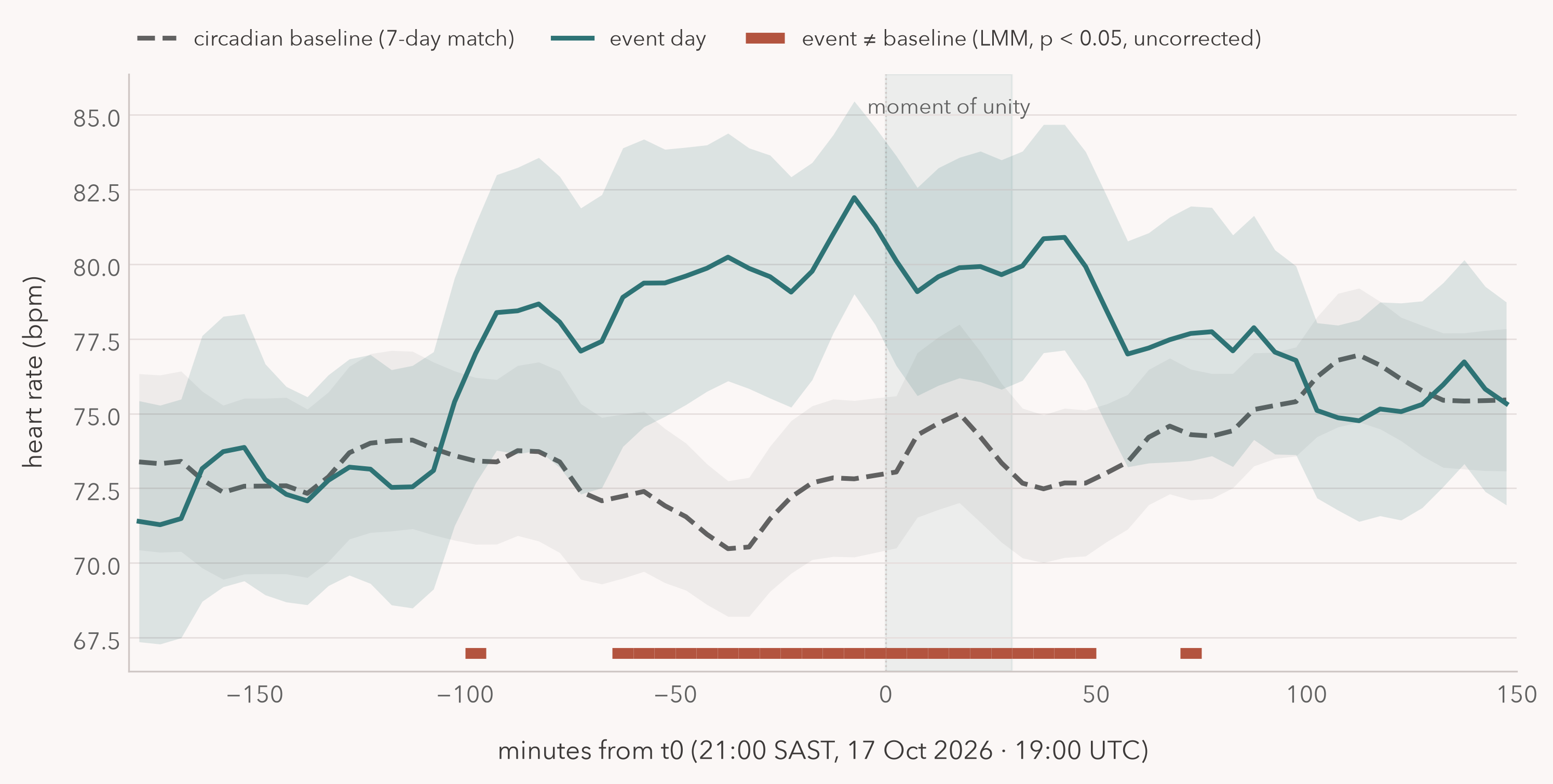
- Heart rate was about 9 bpm above baseline for roughly three hours around the moment of unity. HRV didn't change. That looks like an engaged crowd, not a group settling down.
- Journaled emotion stayed above this cohort's usual pleasantness the whole time, so the index moved on physiology alone: 56 during the moment of unity, 73 the next afternoon when people were resting.
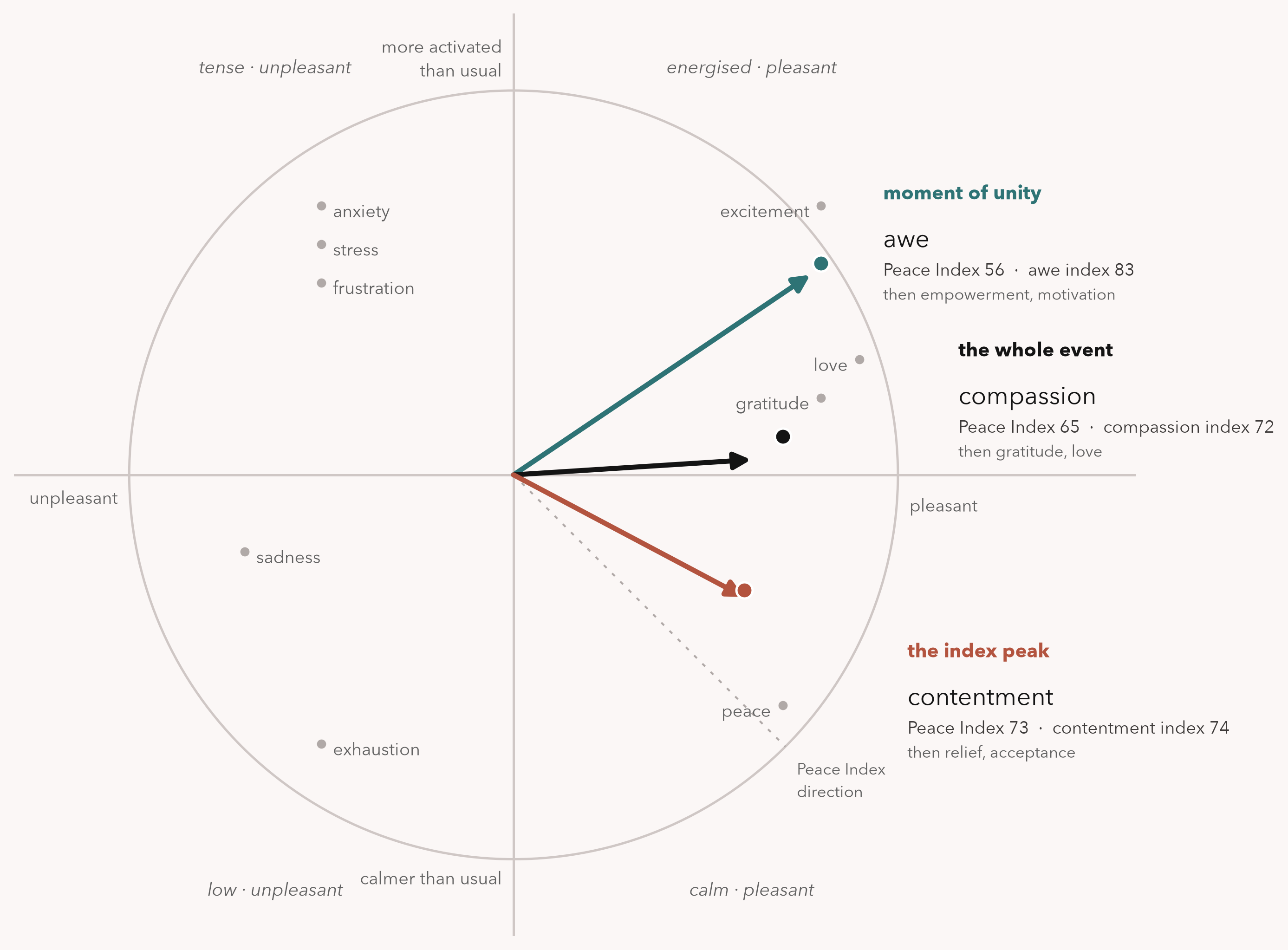
- If you look at the direction of the cohort vector instead of the index value, the moment of unity was closest to awe (awe index 83, Peace Index 56), the festival as a whole to compassion, and the Sunday peak to contentment. The meditation lowered heart rate and the festival raised it, and the index told them apart.
On 17 and 18 October 2026 the Origin Festival ran in Johannesburg, with a moment of unity at 21:00 local time on the Saturday night. The organisers also listed 357 satellite events in 310 places across 55 countries. 251 people registered through the IN TRUTH app and 211 opted in to research use. 37 wore a Garmin, which is currently the only device that gives us continuous beat-to-beat heart data through the app. 20 of them were recording during the moment of unity, a few on site and most remote. 22 feelings were journaled during the event window.
The first post introduced the index at the Global Peace Activation and asked whether it would move during a synchronized meditation. It did. This time the question is different: what does the index do at an event that is pleasant but not calm, and can we use the same data to say which emotion the event was closest to?
The index, in brief
Same construction as the first post. Heart rate and HRV from the wearable set the vertical axis of the circumplex. Each 30-minute window is scored as a percentile against that person's own readings at the same time of day over the previous weeks. Journaled emotion labels set the horizontal axis. Each label in the app's taxonomy has a fixed valence, so the share of pleasant labels in a window places the cohort left or right. Peace is the calm-and-pleasant diagonal. The index is the projection of a moment onto that diagonal, scaled so 50 is an ordinary moment.
Peace is one direction. Awe is another.
The index is a projection of the cohort's (valence, arousal) vector onto one diagonal. The vector itself has a direction, and the direction tells you what kind of pleasant a moment was. We compare that direction to the position of every emotion in the app's taxonomy (55 labels used at least five times across the two events) and report the closest one by angle. We can also project the vector onto any emotion's direction, which gives an index along that emotion on the same scale, with 50 as typical.
Results
Heart rate was up for three hours
In August, cohort heart rate dropped about 9 bpm below each person's circadian baseline during the meditation. Here it went the other way, and it started well before the moment. Heart rate follows baseline through the early evening, starts climbing around 19:20, and is above baseline from 19:55 to 21:50, averaging +9 bpm over that stretch (per-bin linear mixed models against the same clock window on the seven prior days; 25 of 66 bins flagged, 6 to 12 bpm). The moment of unity falls inside that stretch rather than starting it. The half hour itself doesn't differ from the two hours before it (+3.5 bpm, p = .21). After 22:15 no bin differs from baseline.
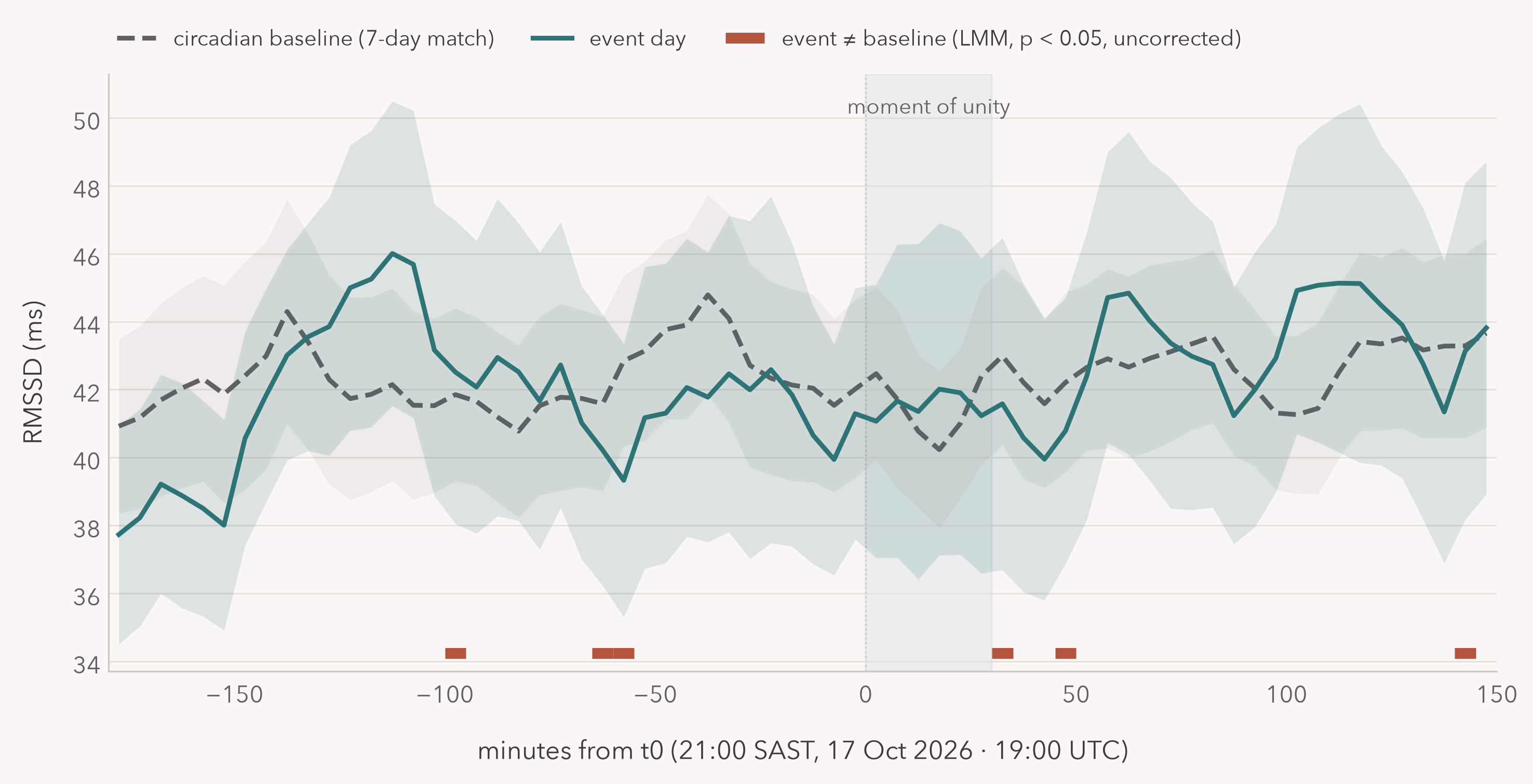
RMSSD, the HRV measure we use for vagal tone, shows no sustained change over the same span (event night vs baseline −7%, p = .17; 6 isolated bins flagged, on both sides of baseline). In August the meditation raised RMSSD 10 to 20% while heart rate fell. Here heart rate went up and RMSSD stayed put. If this were stress I'd expect RMSSD to drop. It reads more like an engaged crowd than a stressed one.
Journals stayed pleasant, so physiology drove the index
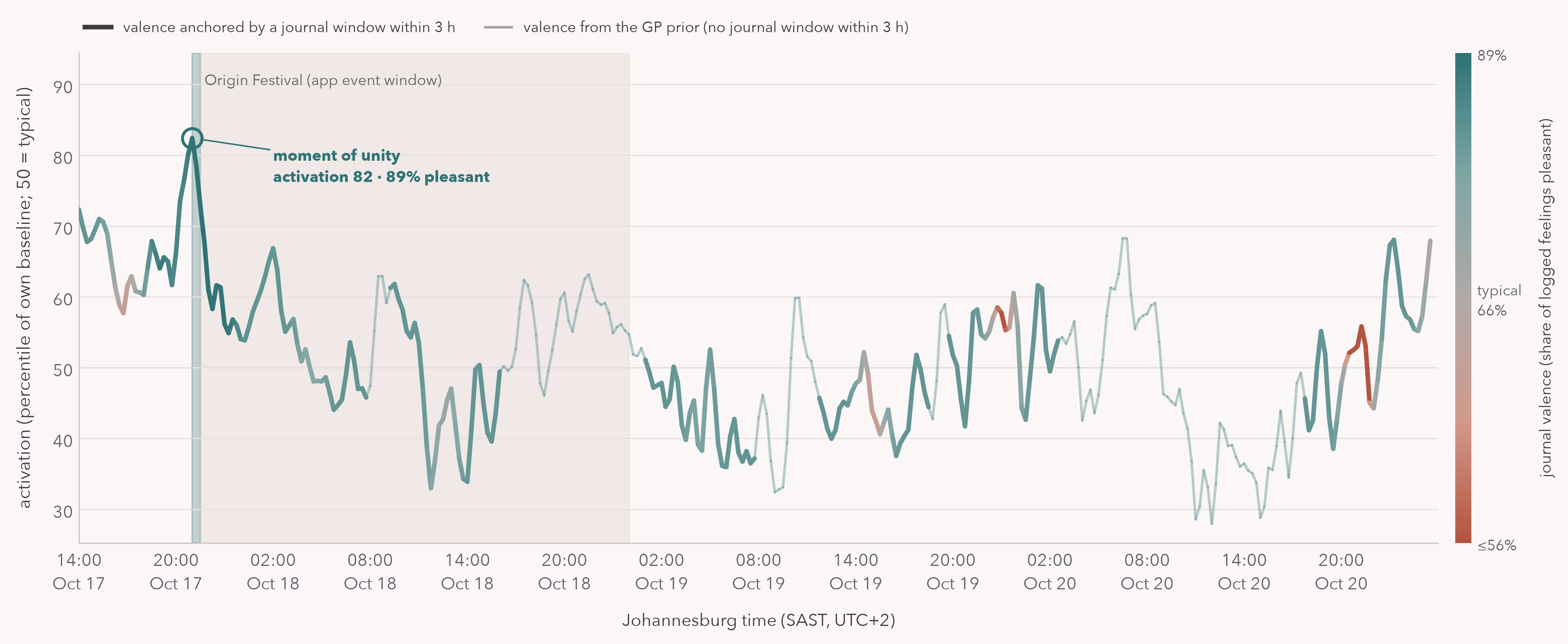
The journal lane barely moved. Wherever the index is defined it sat above this cohort's usual pleasantness, which is 66% of logged feelings. It is also thin: 22 feelings from 6 people in the event window, and most windows rest on one or two journalers. So the lane is a smoothed estimate pulled toward that usual level, not a per-window count, and I don't quote its individual values. For this event the index is almost entirely the biometric lane. The figure below shows both lanes on one line. Height is activation (the calm lane flipped, so 50 is a person's usual activation at that hour). Colour is journaled pleasantness: teal where more of the logged feelings were pleasant than usual, coral where fewer.
Saturday evening is the most activated and most pleasant stretch of the whole span, and the moment of unity is its peak, with activation at 82. Activation came down overnight, sat near typical through Sunday morning, and was below usual for parts of Sunday afternoon. That's where the index peaked, at 73 around 14:00. On the Monday and Tuesday after the festival the cohort was calmer than usual on average, calmer than during the event itself.
The moment of unity
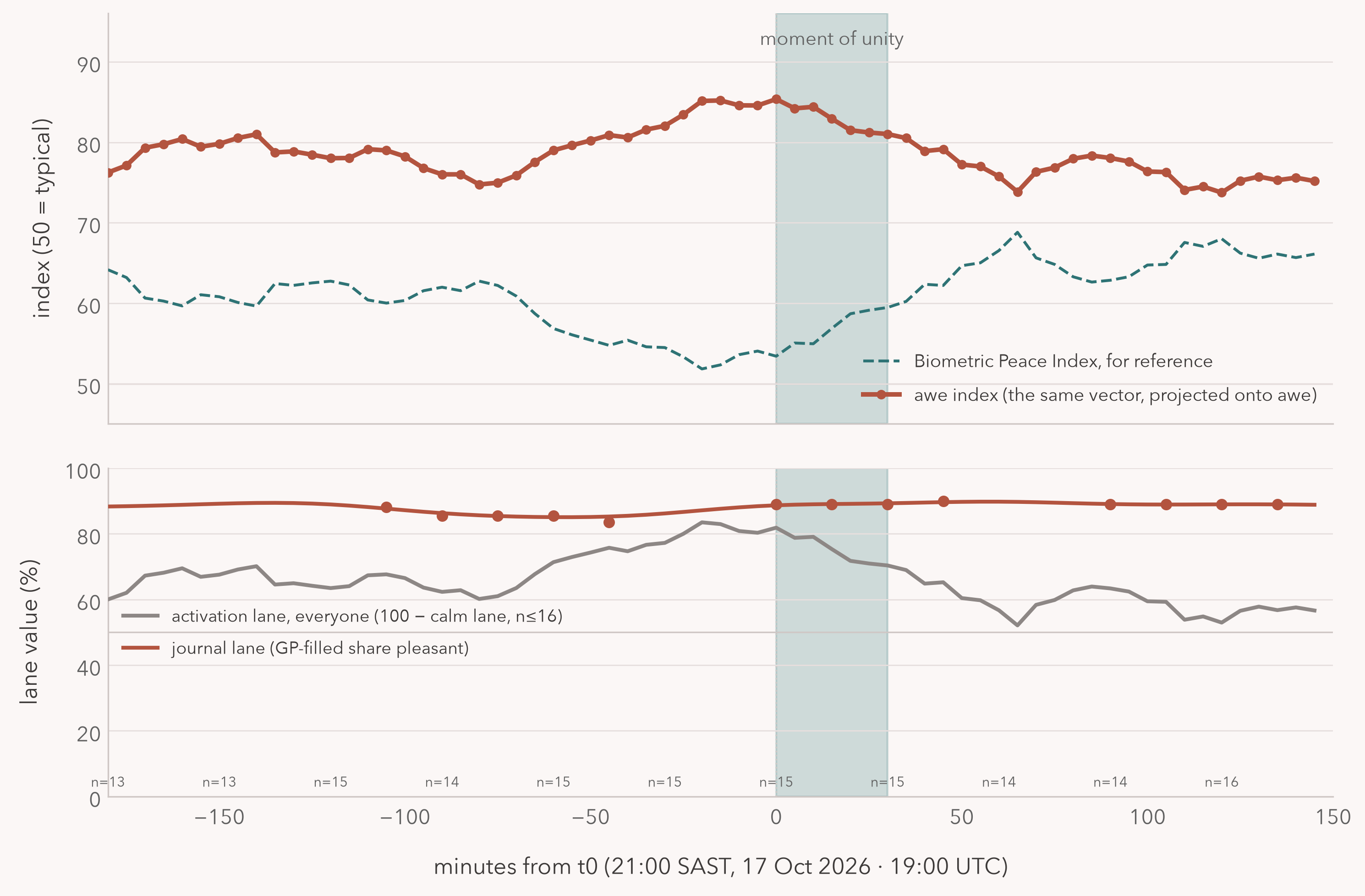
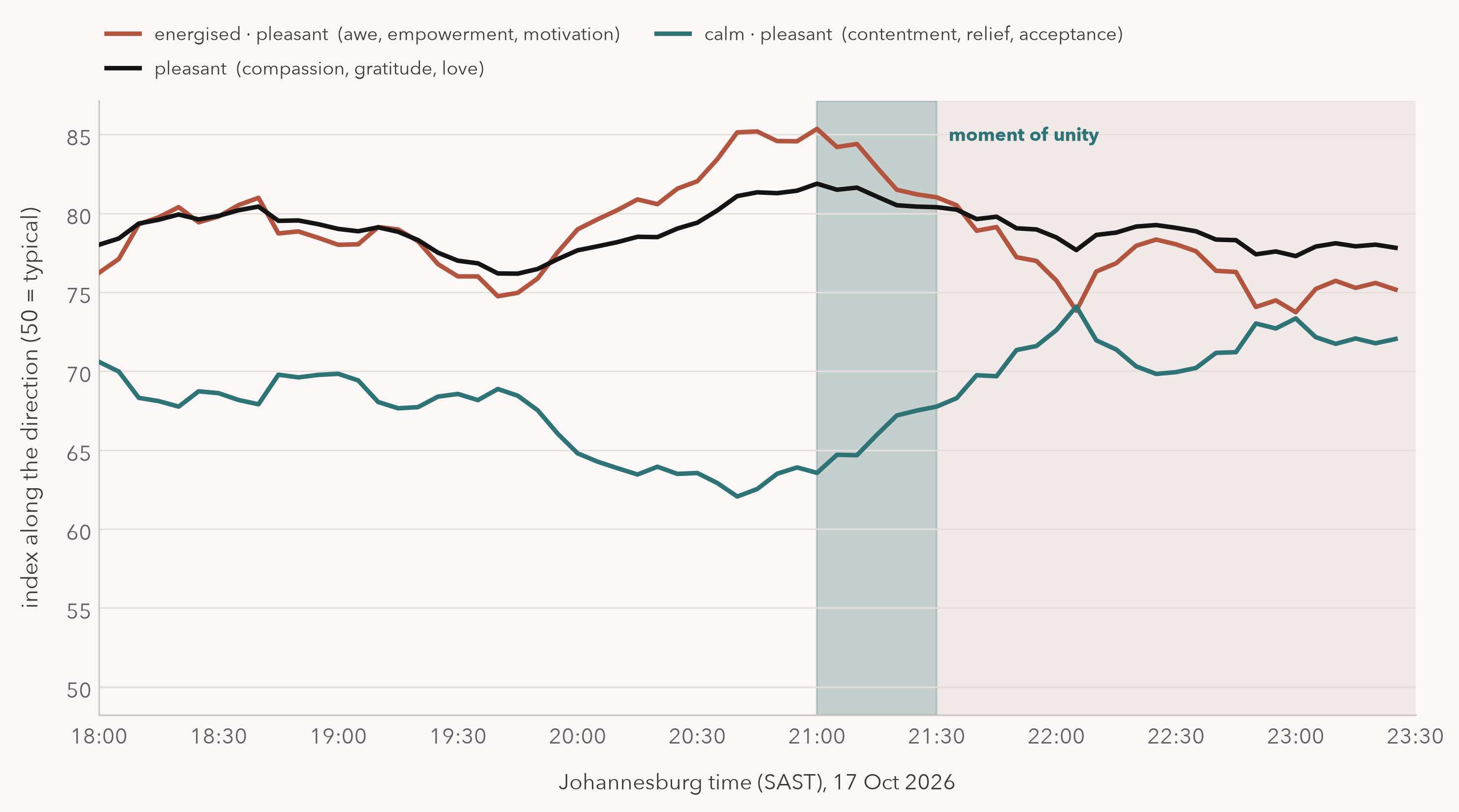
Zooming in to the same hours as the heart-rate figures, 18:00 to 23:30 on the Saturday, and projecting the cohort vector onto awe instead of peace: the awe index was already high going in, 76 at 18:00 and 79 at 20:00, and climbed to 85 by 20:40 as heart rate rose and journals stayed pleasant. It held there into the moment of unity (85 at 21:00, the highest point of the whole weekend) and eased to 81 by 21:30. The mean over the half hour was 83. It then came down to 74 by 22:05 as the heart-rate episode ended.
The Peace Index, drawn dashed for reference, did the opposite. It bottomed at 52 at 20:40, right where the awe index peaked, and averaged 56 over the half hour. Both indices come from the same two lanes. The journal lane kept both pleasant, and the elevated activation pushed the moment toward awe and away from peace.
Which emotion did the festival most align with?
We took the cohort vector at three points (the moment of unity, the whole event, and the index peak) and found the taxonomy emotions closest to it by angle.
The moment of unity is in the energised-and-pleasant corner, strongly pleasant with arousal well above usual. The closest emotion is awe (then empowerment, motivation): Peace Index 56, awe index 83. The whole event, averaged over every window where the index is defined, is pleasant and about as activated as usual. Closest is compassion (then gratitude, love): Peace Index 65, compassion index 72. The Sunday peak at 14:00 is pleasant and calmer than usual. Closest is contentment (then relief, acceptance): Peace Index 73, contentment index 74.
The arc
Step through the festival on the circumplex. Each stop is the cohort's mean vector over that stretch, labelled with the nearest emotion in the taxonomy. Joy going in, awe at the moment of unity, gratitude through the night, compassion by morning, contentment at the Sunday peak, and compassion again in the days after.
Awe gave way to contentment
The Peace Index is one projection of the cohort vector. The same projection can be taken along any direction. The nine emotions above fall into three directions: energised and pleasant (awe, empowerment, motivation), pleasant (compassion, gratitude, love) and calm and pleasant (contentment, relief, acceptance). Over the same hours as the heart-rate figures, the energised line is highest through the early evening and the moment of unity, then falls as the heart-rate episode ends. The calm-and-pleasant line rises from 64 to 74 over the same period, and the two cross at about 22:05. The crowd moved from awe toward contentment as the night went on, and was there by Sunday afternoon.
Two events, two signatures
Both events were pleasant. Only one was peace in the sense the index measures, and the index picked that up. The direction analysis tells us what the other one was.
A synchronized meditation
Heart rate dropped about 9 bpm below each person's circadian baseline at 07:00 UTC, and HRV rose 10 to 20%. Journals were much more pleasant for one day. The index peaked near 80 during the meditation: calm and pleasant at the same time. A dip, a spike, and a return to baseline.
A crowd at a moment of unity
Heart rate was about 9 bpm above baseline for three hours around the moment of unity, and HRV didn't change. Journals stayed pleasant throughout. The index was 56 at the moment of unity (closest to awe) and 73 the next afternoon (closest to contentment). A plateau of pleasant arousal, then rest.
What's next
Every event the app covers now gives us the same four reads: physiology, pleasantness, the Peace Index, and the closest emotion. Two events in, the index can already tell a meditation from a festival. We want to build up a catalogue of these signatures (meditation, festival, ceremony) and eventually a live reading of how a community is doing between events, with causal models that estimate how specific events move it.
The next step is still a pre-registered replication at scale, and we're looking for the same partners as before: continuous physiology at scale, live language data in multiple languages, and cohorts or events you run and want measured before, during and after. If that's you, get in touch.